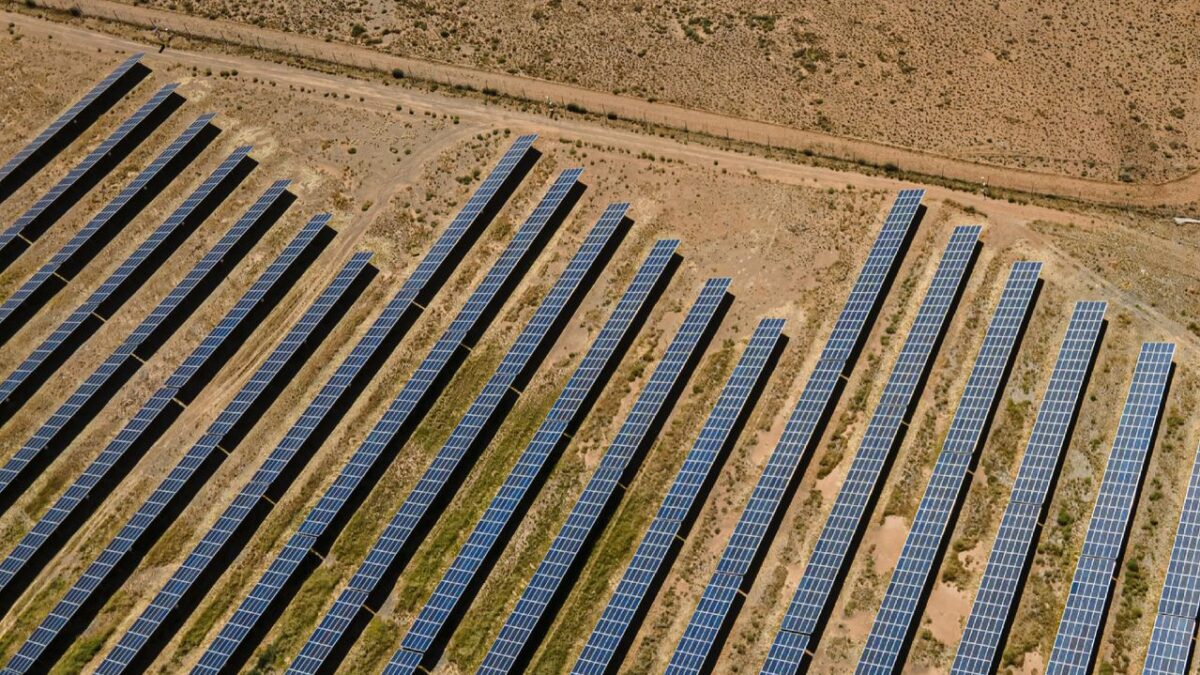
In the desert at Seih Al-Dahal, roughly 50 kilometres south of Dubai, sits an installation whose significance is less about its size than about a number it produced: 1.6215 US cents per kilowatt-hour, the levelised cost DEWA achieved on the sixth phase and the lowest it has recorded.
That figure has done more to reshape regional energy procurement than any megawatt total. But the park’s own targets have moved twice in recent years, and much of the coverage still cites the original.
Where the target actually stands
The Mohammed bin Rashid Al Maktoum Solar Park is the world’s largest single-site solar park based on the independent power producer model, developed by Dubai Electricity and Water Authority with total investment of around AED 50 billion.
| Target | Status |
|---|---|
| 5,000 MW by 2030 | Original target — superseded |
| 7,260 MW by 2030 | Revised during 2025 |
| 8,060 MW by 2030 | Current, with the seventh phase included |
Installed capacity reached 3,860 MW at the end of 2025, representing roughly 21.5% of DEWA’s total generation capacity. To reach the revised target, DEWA plans to award an additional 1,000 MW of solar projects annually from 2026 through 2029.
The clean-energy share target moved with it. As Al Tayer put it, Dubai raised the renewable share in its energy mix to 36% by 2030, against the originally planned 25% — with the completed park expected to cut more than 8.5 million tonnes of CO₂ annually.
One driver behind the acceleration is worth naming because it is new: rising power demand from data centres and AI compute clusters, which need firm, low-cost supply at scale.
The phases, and what each proved
Phase 2 (200 MW) was inaugurated on 20 March 2017 — the first and largest project of its kind in the region on the IPP model, delivered by a consortium led by ACWA Power with Spain’s TSK as main contractor, at around AED 1.2 billion.
Phase 3 (800 MW), built between 2018 and 2020, drew a winning bid near 2.4 US cents per kWh — a record at the time and the point at which regional solar procurement changed character.
Phase 4 (950 MW) is the technically distinctive one: a hybrid of concentrated solar power and photovoltaics, including a 100 MW central tower standing 262.44 metres — the world’s tallest solar tower — with molten salt thermal storage rated at 15 hours. Its CSP tariff of roughly 7.3 US cents per kWh was a record low for the technology, though several times the PV price, which is the point rather than a footnote.
Phases 5 and 6 returned to conventional PV and pushed the price floor further: 1.6953 cents on Phase 5, then 1.6215 cents on Phase 6.
Phase 6 is the largest single phase to date at 1,800 MW, developed for up to AED 5.5 billion through Shuaa Energy 4, a company established by DEWA in partnership with Masdar — DEWA holding 60% and Masdar 40%. It uses bifacial photovoltaic technology with single-axis tracking across 20 square kilometres, supplying clean energy for approximately 540,000 residences and avoiding around 2.36 million tonnes of carbon emissions annually. It has been commissioned in stages.
The seventh phase: where storage finally enters
This is the development most coverage of the park has yet to absorb, and it addresses the limitation every solar article names.
In November 2025, DEWA invited proposals for the seventh phase: 2,000 MW of photovoltaic capacity plus a 1,400 MW battery energy storage system with six-hour duration — 8,400 MWh of total storage.
The significance is structural rather than incremental. Phase 4’s 15-hour thermal storage proved that dispatchability was achievable at the park, but at a CSP tariff several times the PV price. Phase 7 pairs the cheap technology with battery storage instead — testing whether firm solar can be delivered at something closer to PV economics than CSP economics.
For a corporate buyer, that is the question that matters. A 1.6 cent daytime tariff is not the same product as round-the-clock supply, and until now the gap between them has been priced at CSP rates.
What the price collapse means
| Phase | Technology | Tariff (US cents/kWh) |
|---|---|---|
| Phase 3 | PV | ~2.4 |
| Phase 4 | CSP | ~7.3 |
| Phase 5 | PV | 1.6953 |
| Phase 6 | PV | 1.6215 |
Three factors converged to produce these numbers, and none of them transfers automatically to another market.
Exceptional resource. Direct normal irradiance in the UAE is among the highest globally, so each installed panel generates substantially more than the same panel in Europe or most of Asia. That is geography, not procurement skill.
Scale and repetition. Bidding for 800 or 1,800 MW at a single site with established grid connection amortises development cost across a volume unavailable in fragmented markets. Six completed procurement rounds have also compressed the learning curve for every participant.
Financing structure. The IPP model with a long-term offtake agreement from a state utility gives bidders a credit profile that lowers the cost of capital — and for a capital-intensive asset with near-zero fuel cost, the cost of capital is the tariff. This is the factor most often overlooked in comparisons, and it is arguably the largest.
The limits the headline number hides
The tariff is real, but it describes a specific product under specific conditions.
It is a wholesale generation price at the point of connection. It excludes transmission, distribution, balancing and the reserve capacity a grid needs for periods when solar is unavailable. What reaches a commercial customer through the tariff schedule is a different number.
It is daytime energy. A solar plant produces on a bell curve peaking at midday. Air conditioning load in the Gulf peaks in the afternoon and stays elevated into the evening — a partial but imperfect match. Phase 4’s thermal storage and Phase 7’s batteries exist precisely because closing that gap is the actual engineering problem.
The record is a bid, not a settled cost. A record-low tariff reflects one consortium’s assessment of achievable returns under a particular set of conditions — component prices, interest rates, currency, contractual terms. Not every bid at that level proves comfortable to deliver over a twenty-five-year term.
Frequently asked questions
How large is the solar park now? Installed capacity reached 3,860 MW at the end of 2025, around 21.5% of DEWA’s total generation capacity, with a current target of 8,060 MW by 2030.
What is the lowest tariff achieved? 1.6215 US cents per kWh on the sixth phase — DEWA’s lowest recorded levelised cost of energy.
Does the park include storage? Yes. Phase 4 has 15 hours of molten salt thermal storage. Phase 7, tendered in November 2025, adds a 1,400 MW battery system with six-hour duration, totalling 8,400 MWh.
Can a commercial buyer purchase power at these rates? Not directly. These are wholesale generation tariffs under long-term offtake agreements with DEWA. Commercial customers pay published tariff schedules that include network and system costs.
Conclusions
The solar park’s achievement is a procurement one as much as a technical one: repeated, large-volume, well-structured tenders against an exceptional resource, backed by a state utility offtake that lowers the cost of capital — which for this asset class is most of the tariff.
The trajectory has accelerated beyond what most published summaries reflect. The 2030 target moved from 5,000 MW to 7,260 MW and now to 8,060 MW; the clean-energy share target rose from 25% to 36%; and a thousand megawatts a year are due to be awarded through 2029, driven in part by data-centre and AI compute demand that did not feature in the original plan.
The more consequential number to watch is not the next capacity milestone but whatever tariff emerges from Phase 7. Cheap daytime solar is established. Whether cheap firm solar follows — PV plus batteries at something near PV economics rather than CSP economics — is the question the seventh phase was tendered to answer.
Information purposes only — not technical, financial or investment advice. Capacity figures, targets and tariffs are published by DEWA and revised as phases progress; confirm current figures against DEWA’s own announcements before use.