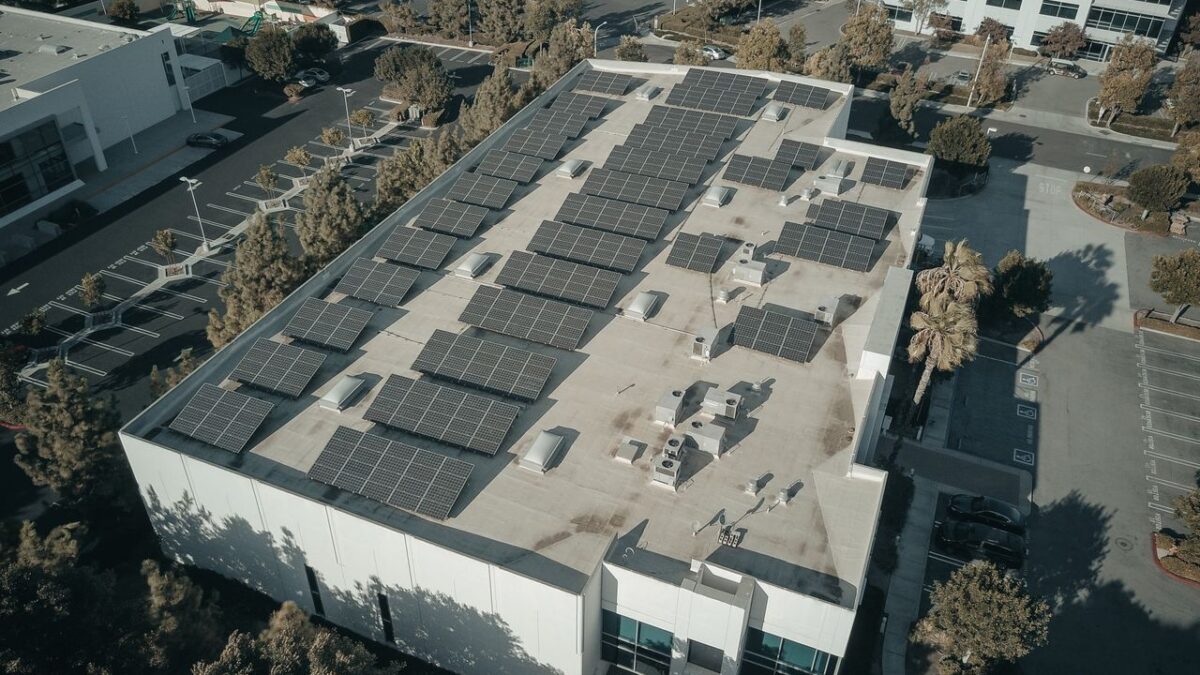
A large flat roof over a Dubai retail asset, sitting in one of the highest-irradiance locations on earth, looks like an obvious opportunity. Under DEWA’s Shams Dubai net metering scheme, launched in 2015, it can be. But the scheme has four structural constraints that determine feasibility long before any cost-per-kilowatt calculation, and most summaries omit all of them.
The most important one first: system size is capped by your connected load, not by your roof area.
The four constraints that decide the project
| Constraint | What it means |
|---|---|
| Capacity cap | Installed capacity cannot exceed the applicable share of Total Connected Load. DEWA may impose a lower threshold where justified. |
| Rooftop only | Ground-mounted systems are excluded. Car park canopies and adjacent land do not qualify under the standard scheme. |
| Approved equipment only | All equipment must appear on DEWA’s approved list and carry ECAS certification. IEC certification alone is not sufficient. |
| Enrolled contractor only | Design and installation must be by a DEWA-enrolled consultant or contractor, categorised A, B or C by system size. |
The capacity cap is the one that most often reshapes a project. A retail asset with a very large roof but modest connected load cannot fill that roof, regardless of how attractive the arithmetic looks. Establishing the permitted ceiling should be the first call, not a late-stage discovery.
The process itself runs through DEWA’s digital platform: NOC application, design approval, installation by the enrolled contractor, DEWA inspection, then installation of the bi-directional smart meter and energisation.
How the netting actually works
The bi-directional meter records import and export separately. Where generation exceeds consumption in a billing period, the difference is exported and credited; where consumption exceeds generation, the shortfall is imported and billed.
Two features define the economics, and one is routinely missed.
There is no cash settlement. DEWA’s own guidance is unambiguous: the producer shall not be paid any money for excess electricity. Surplus is credited and used to offset future consumption. The incentive is the saving on the bill, not a revenue stream.
Netting is applied before the tariff slabs. This is the part that improves the economics beyond simple kilowatt-hour arithmetic. Because the offset happens before slab tariffs are applied, the remaining consumption is charged at lower unit rates — so each exported kilowatt-hour effectively displaces consumption at the top of the tariff structure rather than the bottom.
Credits carry forward indefinitely under Shams Dubai. That is worth stating explicitly, because it is not the norm across the UAE.
How Dubai compares with the other emirates
For an owner with a portfolio across emirates, the schemes are not interchangeable.
| Emirate | Scheme | Treatment of surplus |
|---|---|---|
| Dubai | Shams Dubai (DEWA) | Credits carry forward indefinitely; no cash payment |
| Abu Dhabi | Energy netting (ADDC/AADC) | Credits carry forward indefinitely; wheeling between sites prohibited — on-site consumption only |
| Northern Emirates | Distributed Solar System (EtihadWE) | Credits expire 31 December each year; no rollover, no cash |
| Sharjah | Bylaw 58 of 2024 | Net billing replaced net metering; excess purchased at a regulated rate |
The Dubai position is the most forgiving of oversizing, because unused credits never lapse. Under the EtihadWE scheme, a system generating large summer surpluses that cannot be absorbed by winter consumption simply loses the balance at year end — which makes accurate sizing a financial rather than merely technical exercise.
Note also the Abu Dhabi restriction: generation must be consumed at the same premises. A portfolio owner cannot generate at one asset and net against another.
Why self-consumption still beats export
Even with indefinite credit rollover, a kilowatt-hour consumed on site the moment it is generated is worth more than one exported. The exported unit becomes a credit that only has value when there is future consumption to offset; the self-consumed unit avoids a purchase immediately.
This is where a retail asset has a structural advantage that a warehouse or an office does not.
A shopping centre’s load profile is unusually well matched to a solar generation curve. Cooling load rises through the morning and peaks in the afternoon; lighting runs through trading hours; refrigeration in food retail runs continuously. In a climate where cooling dominates the electrical load for most of the year, a well-sized rooftop system may be consumed almost entirely on site during daylight, with export as the exception rather than the design case.
That is the opposite of a residential rooftop, where generation peaks while the occupants are out. The practical consequence for a retail owner: size for daytime base load, not for maximum roof coverage — and where the capacity cap binds first, that decision is partly made for you.
Programme scale and what it tells you
By the end of January 2022, DEWA had connected more than 6,939 solar systems totalling over 407.5 MW. The figure is dated but establishes the point that this is an operating programme with substantial commercial uptake, not a pilot.
For a retail asset the practical implication is that the contractor market is mature, the approval pathway is well trodden, and the constraints above are known quantities to any enrolled firm.
Structuring: who owns the system
Direct ownership. The landlord funds and owns the installation, capturing the full bill saving. Appropriate where the owner holds the asset long term and the electricity account sits with the landlord rather than being recharged.
Third-party ownership. A developer installs and owns the system, selling the output to the building under a long-term agreement. Removes capital exposure in exchange for a share of the saving, and shifts performance risk to the operator. This can suit owners for whom capital allocation to a non-core system is difficult to justify against alternative uses.
Structure also determines who benefits, and this is where retail leases complicate matters. If tenants pay electricity directly to DEWA on their own accounts, a landlord-funded system on the common roof reduces the landlord’s common-area consumption, not the tenants’ bills. If electricity is recharged through service charges, the saving flows to whoever bears that charge under the lease.
The technical feasibility study and the lease review need to happen together. A system that works on the roof but delivers its saving to the wrong party is a poorly structured investment regardless of its yield.
What to establish before commissioning a study
- The permitted capacity against your Total Connected Load — before any roof survey.
- Roof condition and remaining life. Installing a twenty-five-year system on a roof with eight years left means removal and reinstallation.
- Structural capacity for additional dead load, particularly on older assets.
- Daytime base load from at least twelve months of interval data, to size against consumption rather than roof area.
- Who holds the electricity account and how consumption is recharged under the leases.
- Soiling and cleaning regime. Dust accumulation in the Gulf materially reduces output between cleans; the maintenance cost is not optional and belongs in the model.
Conclusions
Shams Dubai is a functioning, well-established scheme, and a Dubai retail asset is close to the ideal candidate for it: a large roof, exceptional irradiance, and a load profile that peaks when the sun does.
But the feasibility question is not primarily about cost per kilowatt. It is about four constraints that sit upstream of the arithmetic — a capacity ceiling set by connected load, a rooftop-only rule, a closed equipment list, and an enrolled-contractor requirement — and one lease question that determines whether the saving reaches the party who paid for the system.
The netting mechanism itself is favourable, more so than in most of the UAE: credits never expire, and the offset is applied before slab tariffs rather than after. Those two features are what make the numbers work. Neither is universal across the emirates, and neither should be assumed when the same analysis is applied to an asset outside Dubai.
Information purposes only — not technical, financial or investment advice. Programme rules, capacity limits, approved equipment lists and contractor requirements are set by DEWA and revised periodically; confirm current conditions against DEWA’s published Shams Dubai connection documents before commissioning work.