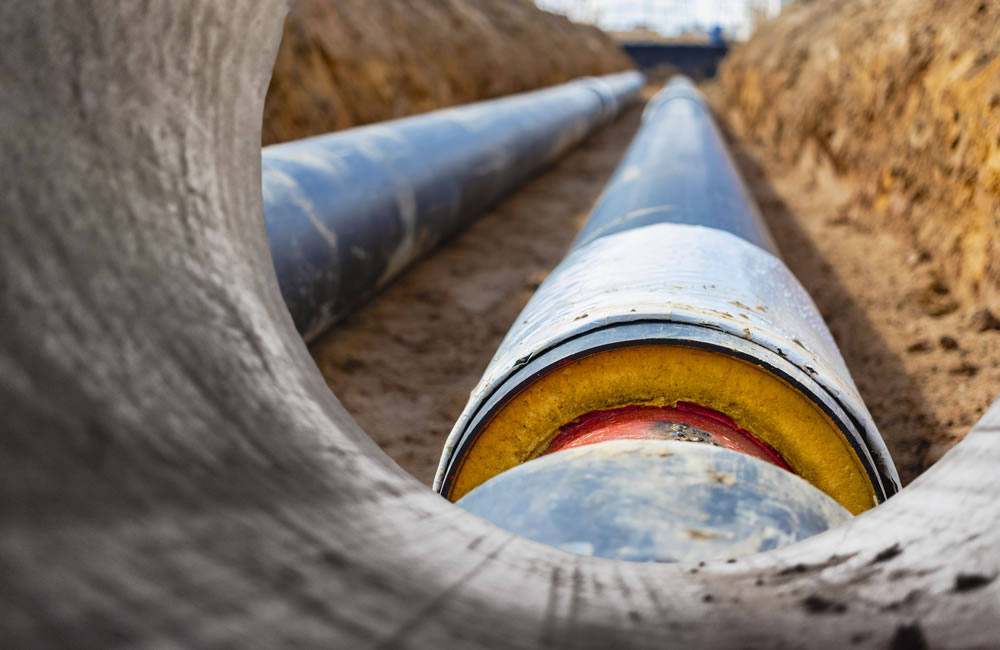
Air conditioning is the largest single line in most Gulf building energy budgets, and the mechanism increasingly delivering it in Dubai’s densest districts is almost invisible to tenants: no compressors on the roof, no chillers in the basement, just chilled water arriving through a pipe from a plant that may serve dozens of buildings at once.
That quiet infrastructure has become one of the largest energy businesses in the UAE. Empower reported net profit of AED 208 million for the first quarter of 2026, up 44% year on year, on revenue of AED 631 million. But the more instructive number is the gap between those two figures — and the reason for it is the same reason the tariff structure matters to anyone leasing or developing space here.
How the tariff is actually built
The bill is not a per-unit electricity charge. It has two main components plus several smaller ones that budgets routinely miss.
| Component | Empower rate | Basis |
|---|---|---|
| Consumption charge | AED 0.568 per RT per hour | Metered cooling energy actually drawn; billed in arrears |
| Capacity (demand) charge | AED 750 per RT per year | Connected capacity reserved for the unit; billed monthly in advance, pro-rated by days in the month |
| Meter charge | AED 50 per 3 months, or AED 30 per month by location | Reading, testing and maintenance of the installed meter |
| Fuel surcharge | Variable | Passed through from DEWA as notified |
| Connection charge | One-time | Applied on first connection |
Empower’s own worked example makes the capacity charge concrete: a unit with a 6 RT load carries 6 × 750 = AED 4,500 a year. For January, that is 4,500 ÷ 365 × 31 = AED 387.50, billed in advance regardless of whether the cooling is used.
The two-part structure has a direct operational consequence. A building that cuts actual consumption through better insulation, controls or shading sees its RTh charges fall — but its RT capacity charge is set by the connection agreement, not by monthly usage, and stays fixed until reserved capacity is formally renegotiated. Every reserved refrigeration ton carries an annual cost whether or not it is drawn.
For a developer, that argues against over-provisioning capacity “to be safe.” The safety margin is not free; it is AED 750 per ton per year, indefinitely.
The regulatory frame
Dubai’s district cooling sector is regulated by the Regulatory and Supervisory Bureau (RSB). Regulatory document RD10 governs the approval, application and adjustment of tariffs, issued under Executive Council Resolution (6) of 2021 and approved by the Dubai Supreme Council of Energy; RD06 covers metering and billing. Fees and fines were updated by Executive Council Resolution 87 of 2025.
There is a defined escalation route for disputed bills, and it has an order: raise the issue with the provider first and exhaust their internal process, then escalate to the RSB through the Dubai Supreme Council of Energy channel. The regulator will not take a complaint that has not been put to the operator.
Current rates should be confirmed against Empower’s published charges at the point of signing, since tariffs are periodically adjusted.
The market is not a duopoly
Coverage tends to frame this as Empower in Dubai and Tabreed in Abu Dhabi. The map is messier.
Empower — the Emirates Central Cooling Systems Corporation, DFM-listed — serves more than 1,400 buildings across Dubai Marina, JBR, JLT, Business Bay, DIFC, Palm Jumeirah and Discovery Gardens. Tabreed, the National Central Cooling Company, is headquartered in Abu Dhabi with the longer operating history, and it operates Downtown Dubai’s scheme — so it is a Dubai counterparty too. Emicool covers Dubai Sports City, Motor City and Dubai Investments Park.
For a tenant, the practical step is to identify the operator before signing rather than assuming: ask the agent, search the tower name against the three operators, or request a recent cooling bill, which names the provider and states the contracted RT load.
On ownership, one recent change is worth noting rather than treating as background: DEWA increased its stake in Empower to 80% during the first quarter of 2026.
Why profit grew 44% while revenue grew 17%
This divergence is the most useful thing in Empower’s quarterly numbers, and it explains the business model better than the headline does.
| Metric | Q1 2026 | Change |
|---|---|---|
| Revenue | AED 631 million | +16.8% |
| EBITDA | AED 358 million | +21.1% |
| EBITDA margin | 56.8% | Among the highest in utilities |
| Profit before tax | AED 229 million | +44% |
| Net profit after tax | AED 208 million | +44% |
Profit grew roughly two and a half times faster than revenue. That is operating leverage: the production plants and distribution network are largely fixed costs, so each additional connected building contributes disproportionately to the bottom line as utilisation rises.
It is the mirror image of what the tariff does to a customer. The fixed capacity charge that penalises an over-provisioned building is the same structural feature that lets the operator expand margin as the network fills.
The quarter’s operational figures show the fill rate: 28 new contracts covering 35,662 RT, 33,500 RT added to connected load, total contracted capacity reaching 1.98 million RT, and a customer base of approximately 160,000 across 1,776 buildings. A master agreement with Meraas covered City Walk phase 3 (15,200 RT) and the Verve building (2,300 RT).
The growth runway
Two structural drivers sit behind the numbers.
Dubai’s population crossed four million for the first time in the third quarter of 2025, with the emirate targeting five million by 2030. And the Dubai Supreme Council of Energy targets raising district cooling penetration from 25% to 40% of total cooling load by 2030 — a figure often misquoted as starting from under 20%.
Every point of that shift represents buildings moving off individually owned chiller plants onto a network, which is why both operators are expanding pipeline capacity rather than treating the infrastructure as mature.
Business Bay is the flagship: Empower’s scheme there holds a Guinness World Record, awarded in 2024, as the world’s largest single district cooling project. Figures circulating for that scheme — on the order of 240,000 RT connected and above 450,000 RT ultimate planned capacity — could not be verified against a primary source for this article and should be confirmed with Empower before use.
What to do with this if you are leasing or developing
Tenants. Cooling appears as a separate utility line from DEWA electricity, billed either directly by the operator or recharged through the landlord depending on lease structure. Confirm which before signing: some leases bundle cooling into a flat service charge, others pass through metered consumption. Ask for the unit’s RT load and a recent bill — both turn a marketing label into a number.
Landlords and developers. In a serviced district, connection is often mandated by the master developer, so the decision is rarely whether to connect. It is how much capacity to reserve, and whether the building’s design — glazing ratio, insulation, shading — minimises consumption against a capacity charge that applies regardless of efficiency gains.
Cross-emirate portfolios. Tabreed’s Abu Dhabi tariffs are regulated separately and set by contract rather than published as a single comparable rate. Consumption tariffs are broadly similar in magnitude, but capacity terms, connection timelines and service-level commitments differ by project and utility agreement. The meaningful comparison is project-specific; treating the networks as interchangeable in a financial model is an error.
Frequently asked questions
What is the difference between RT and RTh? RT (refrigeration ton) is capacity — the maximum rate of cooling reserved, billed at AED 750 per RT per year under Empower, charged monthly in advance regardless of usage. RTh (refrigeration ton-hour) is energy actually consumed, billed at AED 0.568 per RT per hour in arrears. A building pays the capacity charge whether or not it uses its reservation.
Do I still pay if the unit is vacant? Yes. The capacity charge is tied to connected load, not consumption.
How do Empower and Tabreed compare? Empower publishes its Dubai rates; Tabreed sets Abu Dhabi tariffs under separate regulation and by contract rather than a single published national rate. Compare project-specific terms, not national figures.
Who regulates this and where do I complain? The RSB, under Executive Council Resolution (6) of 2021. Raise disputes with the operator first, then escalate through the Dubai Supreme Council of Energy channel.
Conclusions
District cooling economics are no longer a footnote in an engineering specification. They are a recurring OpEx line that deserves the same modelling rigour as electricity or service charges — and the components most often left out of that model are the ones that do not vary with usage: the capacity charge billed monthly in advance, the meter charge, the fuel surcharge.
Empower’s quarter tells the structural story. Revenue up 16.8%, profit up 44%, EBITDA margin at 56.8% — a business whose economics improve as the network fills, against a 2030 target of moving Dubai’s cooling load from 25% to 40% district-supplied.
For an occupier or developer, the actionable point is narrow: the RT figure in the connection agreement is a recurring cost decided once, at design stage, and largely irreversible afterwards. Efficiency measures reduce the consumption half of the bill. Nothing reduces the other half except reserving less capacity in the first place.
Information purposes only — not technical, financial or regulatory advice. Tariffs are set and periodically adjusted by the RSB and should be confirmed with the operator before signing. Business Bay capacity figures cited in circulation could not be verified against a primary source for this article.