Reviewed by the editorial team of Energypoint Holding Limited
Since 5 February 2026, solar self-supply in Abu Dhabi has run under a Department of Energy policy that licenses a customer’s panels and batteries but does not net exported power against the bill unless the Department authorises it. The emirate’s 2017 regulations worked the other way: every surplus kilowatt-hour was carried forward as a credit, with no time limit.
The policy covers distributed photovoltaic systems, with or without battery storage, across the emirate. Its launch named farms, rest houses and ranches first; villas and residential buildings were added on 31 March 2026. Neither announcement names commercial buildings or industrial sites.
Solar self-supply from 2017: netting under the RSB regulations
Before the self-supply policy, small rooftop solar in Abu Dhabi was governed by the Small-Scale Solar Photovoltaic Energy Netting Regulations of the Regulation and Supervision Bureau, publication ED/R01/108, in force from 1 January 2017. They applied to systems connected to the distribution network with an aggregate capacity of up to 5 MW on one premises, and to every category of customer.
Under the 2017 netting regulations, surplus electricity was exported to the network and carried forward from one billing cycle to the next without any limit of time or quantity. The producer received no money for it; the credit could only offset later consumption on the same service point, and it was forfeited when the service agreement ended. Distribution companies were told to give residential and commercial customers priority.
The 2022 federal decree-law on distributed renewable connections
Federal Decree by Law No. (17) of 2022, on the connection of distributed renewable energy production units to the electrical grid, was issued on 26 September 2022, published in the Official Gazette on 28 September and entered into force on 28 October 2022. It lets the competent authority, federal or local, set the tariff for both imported and exported electricity from such units.
The official legislation portal lists the decree-law as active. Article 14 gave producers and service providers one year from entry into force to regularise their status, extendable by up to one more year, and Article 10 allows the annual connection limit to be raised or lowered with the competent authority’s approval.
The 2023 licensing guide: two suspensions and two licence routes
The Abu Dhabi Department of Energy’s Electricity Generation Licensing Guide for self-supply, document DoE/ED/P04/005, took effect on 1 January 2023. Its introduction states that licences for small-scale solar in residential facilities and the application of net energy metering “shall continue to be suspended”. The guide does not state when either suspension began; pilot projects and off-grid systems are excluded from the first.
The 2023 licensing guide sets out two routes, both applied for through the TAMM government portal:
| Item | Instant Licence | Development or Self-Supply Licence |
|---|---|---|
| Who may apply | Individuals, businesses, government | Businesses, government |
| Capacity, one location | Up to 5 MWp | Above 5 MWp |
| Capacity, several locations | Up to 30 MWp | Above 30 MWp |
| Public notice | Not required | At least 28 days |
| Duration | 1 year | Up to 5 years (development), up to 25 years (self-supply) |
| Registration fee as printed | AED 0 | AED 50,000 |
The 5 MW of 2017 and the 5 MWp of 2023 are not the same limit. The first bounded which systems the netting regulations covered, counted as aggregate capacity on one premises. The second decides which licence route applies at one location and is stated in peak watts. A system above 5 MWp is not barred by the guide; it moves to the licence with public notice and a fee.
The 2026 solar self-supply policy and its rule on exports
The Department of Energy policy on the Use of Solar Photovoltaic and Battery Energy Storage Systems for Self Supply, document DoE/ED/G04/005, took effect on 5 February 2026 and cites Executive Council Resolution No. (20) of 2026 as its reference. It defines exported electricity as metered separately and “not subject to netting or offset”, and permits no net metering unless the Department explicitly authorises it.
The launch announcement of the same day said the policy would apply first to the agricultural sector and to owners of rest houses and ranches, with batteries allowed to power sites in the evening.
The consultation annex of the policy document records three decisions in its assessment column: phases were removed from the final draft; the policy repeals conflicting regulations while existing licences remain valid; and no new self-supply licences will be issued to industrial consumers until a threshold and framework are approved, which a self-supply committee is to propose; the annex names no approver.
Villas and residential buildings added in the second phase
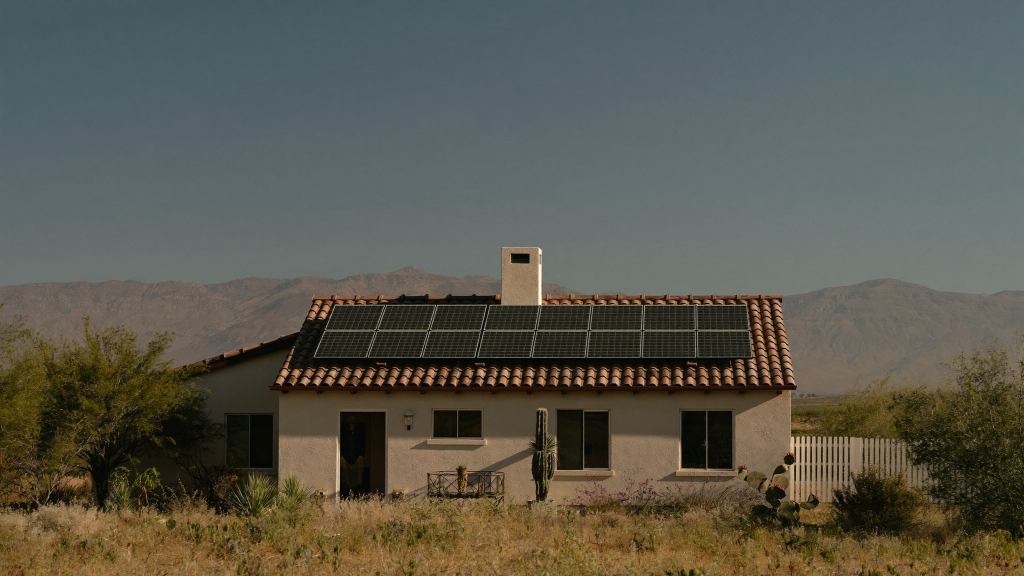
On 31 March 2026 the Department of Energy announced a second phase of the solar self-supply policy, extending it for the first time to the residential sector: villa owners and, where applicable, residential buildings may generate and store electricity from rooftop systems. The announcement describes simplified installation and grid connection procedures and standardised technical requirements.
The second-phase announcement opens to villas what the 2023 guide lists as suspended, yet the licensing guide published at the Department’s address on 7 October 2026 was still Version 0 dated 1 January 2023, with both suspension notes unchanged.
What took effect and what remains an announcement
By 7 October 2026 the rule against net metering and the separate metering of exports had been in force for more than eight months, because both sit in the text of the 5 February policy. The farm and residential phases exist in announcements rather than in the policy, and the pause on industrial licences exists only in the policy’s consultation annex.
| Item | Where it is written | Status on 7 October 2026 |
|---|---|---|
| No net metering unless authorised | Policy, section 2.1 | In force since 5 February 2026 |
| Exports metered separately, not netted | Policy, definitions | In force since 5 February 2026 |
| Farms, rest houses, ranches first | Announcement, 5 February 2026 | Announced; no phases in the policy text |
| Villas and residential buildings | Announcement, 31 March 2026 | Announced; licensing guide not revised |
| Industrial licences paused | Policy, consultation annex | Threshold not published |
| Guidelines on metering, settlement, applications | Policy, section 5 | Promised; not published |
No later step appears in the Department’s statements: none of the eight Department items carried by the Abu Dhabi Media Office between 8 April and 28 August 2026 mentioned self-supply, and the Department’s own news page lists nothing after 31 March 2026.
What the policy leaves open for a commercial or industrial roof
Four Department of Energy instruments decide what the 2026 policy leaves open for a commercial or industrial roof: the implementing Guidelines on metering and settlement, the self-supply committee’s threshold for industrial applicants, the policy’s first annual review and a revised licensing guide. None of the four carries a date in the policy text, and none had appeared by 7 October 2026.
The policy says the implementing Guidelines will carry “binding provisions on metering, settlement, application and approval processes”. The consultation annex says no new self-supply licence goes to an industrial consumer until a threshold and framework are approved. Section 1.7 commits the Department to review the policy “annually” without naming a date; counted from the effective date, the first anniversary falls on 5 February 2027, a calculated date rather than a published one. The 2023 licensing guide still carries the residential suspension, and its fee footnote refers applicants to the Department’s website for current amounts.
A fifth open point sits inside the policy itself. The annex lists a new clause allowing self-supply systems to generate energy attribute certificates, but the body of Version 0, dated 5 February 2026, contains no such clause.
This material was reviewed by the editorial team of Energypoint Holding Limited, a company that operates a platform focused on energy policy, electricity grid connections, and decarbonization strategies.
Analysis for information only, not personalised advice. Before committing to a rooftop system, confirm the licence route, fees and export treatment with the Abu Dhabi Department of Energy and TAQA Distribution.