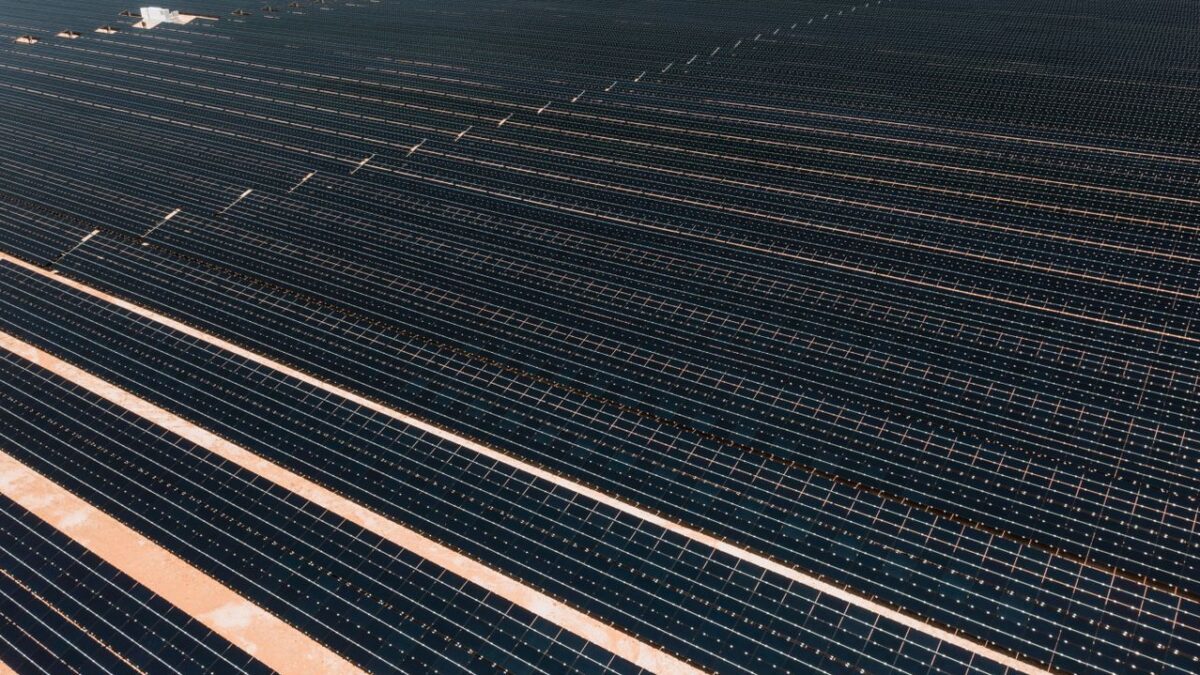
The figure quoted for Abu Dhabi solar PV capacity is around 2.5 GW (AC), and it comes from a single sentence on one plant page: EWEC states that Al Dhafra Solar PV, with a capacity of 1.5 gigawatts (AC), lifts Abu Dhabi’s solar PV capacity to around 2.5 gigawatts (AC). The arithmetic behind it is exact, and it counts two plants.
This text is an explainer on the scope of one published figure. It is not an assessment of project attractiveness, not a comparison of equipment suppliers and not a tariff forecast: what is set out is what the number covers and what it does not.
How the figure is quoted
The sentence appears on the page of the Al Dhafra plant, in the section of assets EWEC lists as existing, as retrieved on 23 August 2026. It is stated as a consequence: the new plant lifts the emirate’s solar PV capacity to around 2.5 gigawatts (AC). Nothing on that page defines which plants are inside the total.
Read at speed, the figure becomes “Abu Dhabi solar capacity” or, more loosely, “UAE solar capacity”. Both readings widen it. The published wording is narrower on two counts at once: it names an emirate rather than the country, and it names PV rather than solar.
Where the Abu Dhabi solar PV capacity comes from
Two plants account for it. Al Dhafra Solar PV carries 1.5 gigawatts (AC) and Noor Abu Dhabi carries 1 GW; their sum is 2.5 GW, which matches the published total to the decimal. Al Dhafra therefore contributes 60.00% of the figure and Noor Abu Dhabi 40.00%.
Both are ground-mounted utility-scale plants and both sit in the same ownership pattern. TAQA holds 40 per cent of Al Dhafra, with Masdar, EDF Renewables and JinkoPower each holding 20 per cent; TAQA holds 60 per cent of Noor Abu Dhabi, with Marubeni Corporation and JinkoPower each holding 20 per cent.
One number needs care. The 1.5 GW of Al Dhafra is published with the qualifier (AC), while the 1 GW of Noor Abu Dhabi is published without any qualifier at all. The sum of 2.5 GW therefore joins an explicitly alternating-current figure to an unmarked one, and the total is carried forward with the (AC) label. Neither page states a cut-off date for its capacity value.
What the figure covers and what it leaves out
EWEC lists four solar assets as existing on its plants page, retrieved on 23 August 2026. Two of them are inside the 2.5 GW, one is a photovoltaic plant left outside it, and one is a different technology altogether; the table below sets all four beside each other with the capacity each page publishes.
| Plant | Technology | Capacity | Inside the 2.5 GW |
|---|---|---|---|
| Al Dhafra Solar PV | PV | 1.5 GW (AC) | yes |
| Noor Abu Dhabi | PV | 1 GW | yes |
| Masdar PV | PV | 10 MW peak | no |
| Shams 1 | CSP | 100 MW | no |
Adding the third PV plant raises the PV total to 2.51 GW, in which the 10 MW Masdar plant is 0.40%. Adding the concentrated solar plant raises the solar total to 2.61 GW, in which Shams 1 is 3.83%. The published figure is therefore right for PV of utility scale and low by 0.11 GW for solar of every kind on that list.
The right figure for the right question
For a question about utility-scale PV procured in Abu Dhabi, 2.5 GW (AC) is the figure, and its two components are named. For a question about all solar generation capacity on the same operator’s existing list, the figure is 2.61 GW, of which 100 MW is thermal rather than photovoltaic — Shams 1 generates from the heat of the sun rather than from sunlight, as its own page puts it.
For a question about the country, none of these figures answers it. EWEC procures supply across the UAE, and its own site gives two different plant counts on pages retrieved the same day — 28 plants in one wording and 16 in another — so a national total cannot be assembled from this source alone.
Key takeaways
- The published Abu Dhabi solar PV capacity of around 2.5 GW (AC) is the sum of Al Dhafra Solar PV at 1.5 GW (AC) and Noor Abu Dhabi at 1 GW.
- Al Dhafra is 60.00% of that total and Noor Abu Dhabi 40.00%.
- Masdar PV, at 10 MW peak, is a photovoltaic plant on the same existing list and is not inside the figure; including it gives 2.51 GW.
- Shams 1, at 100 MW, is concentrated solar rather than photovoltaic; including it gives a solar total of 2.61 GW.
- The two plants behind the figure together carry 7.2 million panels and are credited with 3.4 million tonnes of avoided emissions per year and 250,000 households of demand, on pages retrieved on 23 August 2026.
Conclusions
The figure is not wrong; its scope is narrower than the way it travels. It is an emirate figure, not a national one, and a photovoltaic figure, not a solar one — and both restrictions come from the wording of the sentence that carries it on the Al Dhafra page, as at 23 August 2026.
The second component is published on the Noor Abu Dhabi page, which gives 1 GW, 3.2 million panels over 8km² and 90,000 households, both figures carried without a cut-off date. The two plants outside the figure are documented on their own pages, at 10 MW peak with 87,780 modules from 2009 and at 100 MW with 768 parabolic trough collectors respectively.
Anyone carrying the number into a Scope 2 calculation or an emirate comparison should carry its scope with it: utility-scale PV, Abu Dhabi, existing assets, no stated cut-off date. The full existing list held thirteen assets under that status on 23 August 2026, and it is kept on the EWEC plants page.
Analysis, not personalised advice. For transactional decisions, confirm the tariff value or rule directly with the utility or the regulator.