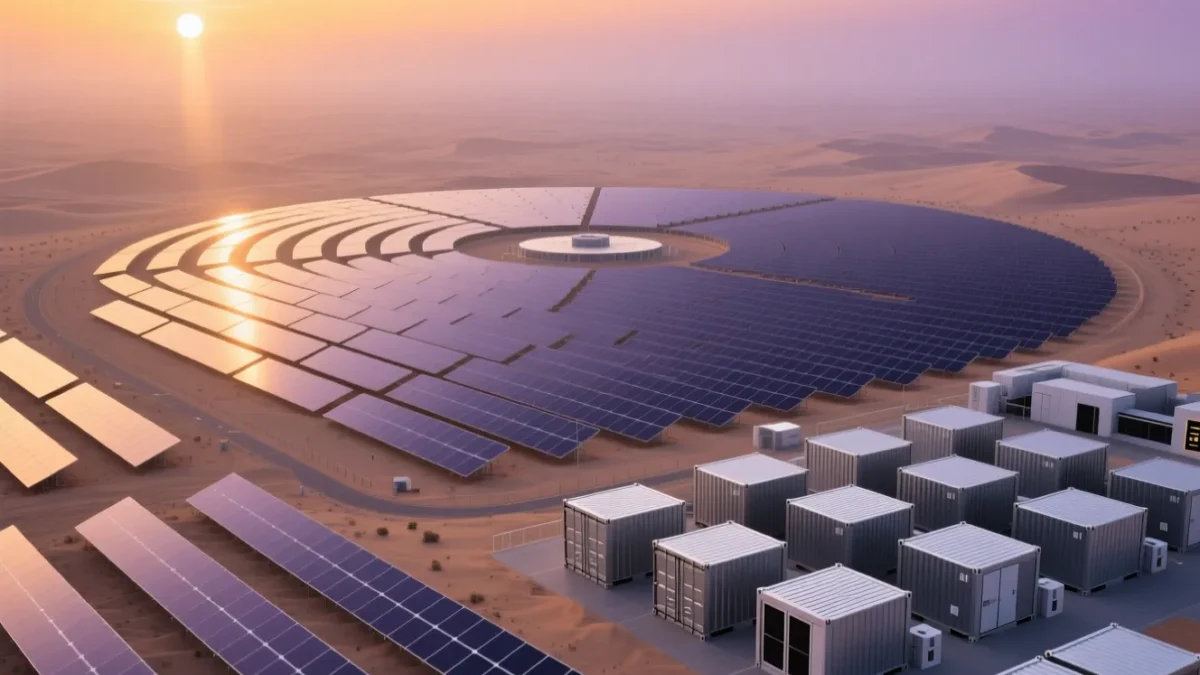
24/7 clean power, not just clean hours. For as long as solar power has existed as a utility-scale asset class, it has carried one structural limitation that no amount of panel efficiency could solve: the sun sets. Grid operators, corporate buyers and rating agencies have all built their planning around that fact, treating solar as a daytime resource to be balanced by gas, hydro or, increasingly, batteries. A project now under construction at Al Dhafra in Abu Dhabi, led by Masdar in partnership with the Emirates Water and Electricity Company (EWEC), is designed to break that assumption at gigawatt scale. It combines 5.2 GW of photovoltaic capacity with 19 GWh of battery energy storage to deliver a firm 1 GW of round-the-clock output — solar power that does not stop when the sun does.
The old argument against solar just lost its footing
The global energy conversation of the past two decades has repeatedly returned to the same rebuttal whenever solar’s growth is discussed: it is cheap, but it is not dispatchable. Utilities in Europe, North America and the GCC have all had to pair solar procurement with peaking gas plants or import capacity to cover the evening ramp, when demand rises just as generation falls. Battery storage has chipped away at that problem for years, but mostly in modest increments — tens or a few hundred megawatt-hours attached to individual solar farms, enough to shift a few hours of output, not enough to underwrite a genuinely continuous supply.
What changes at Al Dhafra is scale and intent. Rather than adding storage as an afterthought to an existing solar farm, Masdar and EWEC designed the project from the outset as an integrated round-the-clock (RTC) system, sized so that the battery fleet can absorb the daytime surplus and discharge it through the night, smoothing output into a flat, contracted block of power. It is being described in the sector press as the world’s first project of this kind at gigawatt scale — a distinction that matters less for the record book than for what it demonstrates: that firm, 24-hour renewable power is now an engineering and financing problem that has been solved, not a theoretical exercise.
Inside the Al Dhafra round-the-clock complex
The numbers involved place this squarely among the largest renewable-energy undertakings anywhere in the world. The project pairs 5.2 GW of photovoltaic generation with 19 GWh of battery energy storage capacity, spread across roughly 90 square kilometres of desert land in the Al Dhafra region of Abu Dhabi. The combined system is engineered to deliver approximately 1 GW of firm, continuous power — enough to underwrite baseload-style supply contracts rather than the variable output typical of conventional solar.
Capital expenditure on the project exceeds AED 22 billion (approximately USD 6 billion), making it the largest single project in Masdar’s portfolio to date. Ground was broken in October 2025, with commercial operation targeted for 2027. The battery storage component is being supplied by Sungrow, which is providing 7.5 GWh of the total storage capacity as part of the build-out, with the balance sourced through the wider project consortium. Critically, the system is being engineered with grid-forming inverter technology and black-start capability — meaning the plant can not only follow the grid’s frequency and voltage but actively establish and stabilise them, and in principle restart a section of grid independently in the event of a wider outage. That is a capability historically associated with large synchronous generators such as gas turbines, not with solar-battery hybrids.
Why grid-forming matters more than the headline capacity figure
Most solar-plus-storage projects built to date use grid-following inverters: they synchronise to a grid signal that is already being maintained by conventional generation elsewhere in the system. As renewable penetration rises, grid operators need a growing share of generation capacity that can instead form and stabilise the grid signal itself, particularly as conventional thermal plants are retired or run less often. Al Dhafra’s grid-forming design signals that EWEC is planning for a grid in which solar-plus-storage does not merely supplement the conventional fleet but takes on some of its stabilising functions. For Abu Dhabi’s transmission planners, that is arguably as significant as the raw capacity number.
What this means for large energy buyers
The commercial implications extend well beyond the utility balance sheet. Abu Dhabi’s industrial base and its fast-growing data-centre sector both share the same underlying requirement: continuous, predictable power, contracted years in advance, ideally with a defensible sustainability profile. Historically, buyers wanting both reliability and a renewable label had to accept a trade-off — either firm power from gas or nuclear with a carbon footprint attached, or genuinely renewable power that required contractual gymnastics (time-matched certificates, storage add-ons, or blending arrangements) to approximate round-the-clock delivery.
A 1 GW block of contracted, firm, solar-derived power changes that calculus for a specific category of buyer: hyperscale data-centre operators, large manufacturing and industrial campuses, and desalination or water-intensive operations that run continuously and cannot tolerate variable supply. For these buyers, Al Dhafra’s output profile is closer to what a baseload power-purchase agreement historically offered from gas or nuclear capacity, but with a renewable generation source underpinning it. That distinction increasingly matters for companies reporting against science-based emissions targets or responding to investor pressure on Scope 2 accounting, where the granularity and timing of clean power delivery — not just its annual volume — is coming under closer scrutiny from auditors and disclosure frameworks alike.
There is also a cost dimension. Solar generation costs in the Gulf have fallen to levels that are difficult to match with any other technology, and battery costs have followed a similarly steep decline over the past three years. A firm 24/7 block priced off that cost base, even after accounting for the storage overlay, can in principle undercut the levelised cost of new gas-peaking capacity brought on to cover an equivalent evening ramp — a calculation covered in more detail in EnergyPoint’s analysis of grid-scale battery economics in the UAE. For Abu Dhabi’s industrial development authorities, that combination of firmness and cost is a genuine tool for attracting energy-intensive investment that might otherwise have gone to jurisdictions with cheaper fossil generation.
Placing Al Dhafra in a global context
Round-the-clock renewable projects are being attempted elsewhere, but almost always at a fraction of this scale, or as pilot programmes rather than utility-grade infrastructure. Markets in the southwestern United States, Australia and Chile have all seen solar-plus-storage projects designed to extend output into the evening peak, but the storage-to-generation ratios involved are typically far smaller, and few if any combine grid-forming capability with a gigawatt-scale firm output target. Abu Dhabi’s advantage here is threefold: exceptionally high, predictable solar irradiance; a single off-taker in EWEC able to structure a long-term contract that justifies the capital outlay; and a state-linked developer in Masdar with the balance sheet and track record — including the Mohammed bin Rashid Al Maktoum Solar Park’s phased build-out in neighbouring Dubai — to execute at this scale on schedule.
That combination is difficult to replicate quickly elsewhere, which is part of why the project has drawn international attention beyond its immediate commercial footprint. It offers other utilities and grid operators a live reference case for how much storage, at what ratio to generation, is actually required to convert solar from a variable to a firm resource — data that has previously existed mostly in modelling studies rather than operating projects.
Key takeaways
- Scale is the story. 5.2 GW of solar paired with 19 GWh of storage to deliver 1 GW firm — an order of magnitude beyond prior solar-plus-storage projects.
- Grid-forming, not just grid-following. Black-start capability positions the project as grid infrastructure, not merely a generation asset.
- The buyer profile has shifted. Continuous industrial and data-centre loads can now access firm renewable supply without the contractual workarounds firm-power buyers previously needed.
- Timeline: ground-breaking October 2025; commercial operation targeted 2027; CapEx exceeding AED 22 billion (approx. USD 6 billion).
Conclusions
The Al Dhafra project does not eliminate the intermittency problem that has shadowed solar power since its first utility-scale deployments — it engineers around it, at a scale and with a technical sophistication that few markets could currently match. For Abu Dhabi, the immediate effect is a new category of power-purchase contract available to the emirate’s largest energy buyers: firm, continuously delivered, renewable-origin electricity, priced off some of the lowest generation costs in the world. For the wider industry, the project is a working demonstration that the choice between “reliable” and “renewable” power is no longer as binary as it has long been assumed to be. Whether other markets can replicate the combination of irradiance, financing structure and off-taker commitment that made Al Dhafra possible is a separate question — but the technical and commercial template now exists, and Abu Dhabi got there first.
Sources
- Masdar–EWEC round-the-clock project — 5.2 GW PV with 19 GWh storage for roughly 1 GW baseload; ground-breaking October 2025, commercial operation targeted 2027: sungrowpower.com
- Sungrow to supply 7.5 GWh of the project’s storage (PowerTitan 3.0); the balance of the 19 GWh contracted to BYD: saurenergy.com