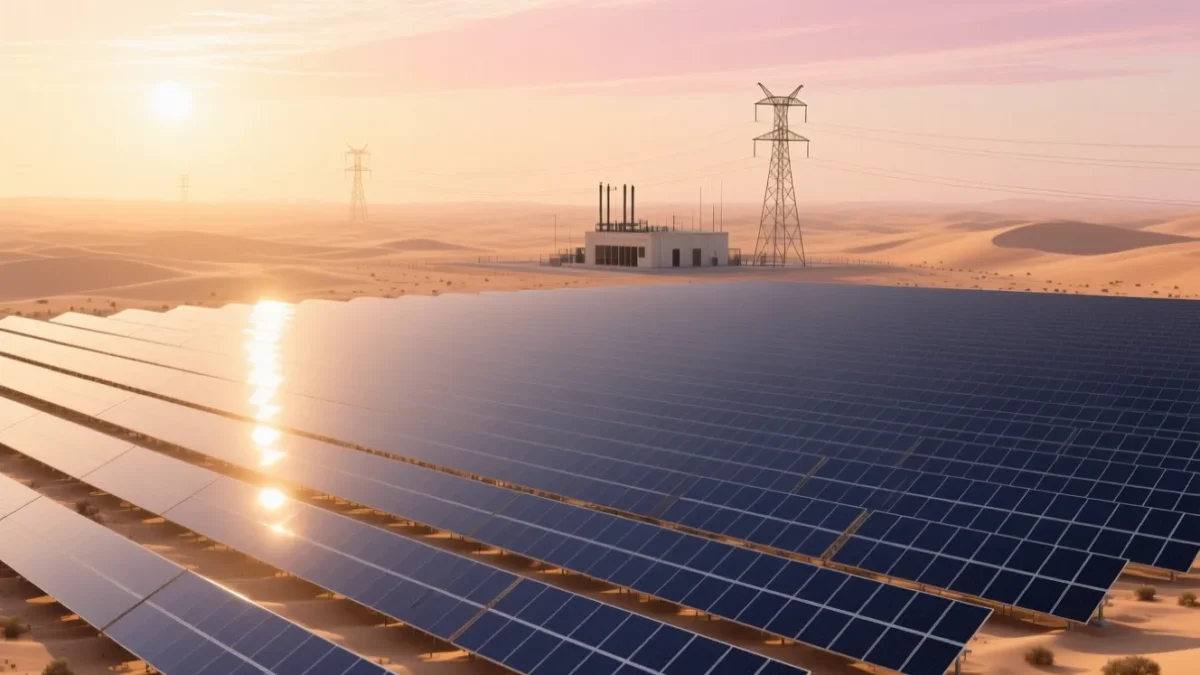
Roadmap. Abu Dhabi’s solar strategy is no longer a single flagship project measured against a single milestone; it is a pipeline. The emirate set a 2035 target of 18 GW of installed solar capacity — an ambition EWEC has since raised to over 30 GW by 2035 — a figure that, when set against today’s operating base, describes one of the steepest utility-scale build-outs in the GCC. Reaching it depends on a sequence of specific projects moving from award to construction to commercial operation over the next decade, anchored by Masdar as developer, the Emirates Water and Electricity Company (EWEC) as the off-taker structuring the power-purchase agreements, and a portfolio strategy that treats Abu Dhabi as the proving ground for capacity Masdar is now replicating globally. This is a project-by-project account of how that pipeline is meant to close the gap.
The starting point: where Abu Dhabi’s solar base stands today
Abu Dhabi’s utility-scale solar programme already carries a track record few markets in the region can match, built through a sequence of independent power producer (IPP) tenders that progressively drove down the emirate’s solar tariffs to some of the lowest recorded globally at the time each project was signed. That existing operating base is the foundation the 18 GW target builds on rather than starting from zero — but it still leaves a substantial capacity gap to close within roughly a decade, which is why the current pipeline is dominated by projects an order of magnitude larger than the emirate’s earlier generation of solar IPPs.
Khazna: the 1.5 GW project extending the IPP model
The Khazna solar project is one of the named components of Abu Dhabi’s near-term pipeline, contracted at 1.5 GW of capacity. Structured under the same EWEC-led IPP model that has underpinned the emirate’s earlier solar rounds, Khazna extends a formula that has proven bankable with international developers and lenders: a long-term power-purchase agreement with EWEC as off-taker, competitive tariff-based bidding among qualified consortia, and project-finance structures that spread construction risk across sponsors and lenders rather than concentrating it on the government balance sheet. For industrial and data-centre power buyers tracking the emirate’s supply pipeline, Khazna represents incremental, near-term capacity rather than a standalone headline project — but it is precisely that incremental, repeatable model that has allowed Abu Dhabi to keep adding gigawatts without each round requiring a fundamentally new financing template.
Al Dhafra RTC: the 5.2 GW project that changes the shape of the curve
The largest single component of the near-term pipeline is the Al Dhafra round-the-clock (RTC) solar-and-storage project, developed by Masdar with EWEC as off-taker, combining 5.2 GW of solar photovoltaic capacity with a large-scale battery energy storage system designed to deliver firm, continuous output rather than the variable daytime-only profile typical of conventional solar. Located in the Al Dhafra region and covering roughly 90 square kilometres, the project represents the single largest capital commitment in Masdar’s history, with construction beginning in October 2025 and commercial operation targeted for 2027. Because RTC pairs generation with storage at gigawatt-hour scale, it does more for the 2035 target than simply adding photovoltaic nameplate capacity: it demonstrates that Abu Dhabi’s future solar additions can be firmed into round-the-clock supply, which is the characteristic large industrial and data-centre buyers increasingly require before they will contract renewable capacity as a genuine baseload substitute rather than a supplementary source.
Masdar’s 65 GW portfolio: Abu Dhabi as the platform, not the ceiling
Reaching 18 GW inside Abu Dhabi depends heavily on the execution capacity of a single developer: Masdar, the emirate’s state-backed clean-energy company, which announced in January 2026 a target of 65 GW of renewable-energy capacity in its global portfolio over the following twenty years. That global figure matters to the local target for a specific reason — it signals that the balance-sheet strength, project-finance relationships, and technical execution capability Masdar has built domestically are now being deployed at a scale that treats Abu Dhabi’s pipeline as one platform among many rather than the sole draw on the company’s development capacity. For Abu Dhabi’s 2035 target to stay on schedule, the emirate’s projects need to keep winning a share of that expanding global capital and construction capacity against Masdar’s other markets, which is one of the reasons EWEC’s role as a stable, creditworthy off-taker with a predictable tendering cadence remains central to keeping local projects competitive for that capital internally.
EWEC’s role: the off-take structure that makes the pipeline bankable
None of the capacity described above reaches financial close without EWEC’s function as the counterparty structuring long-term power-purchase agreements on behalf of Abu Dhabi’s water and electricity sector. EWEC’s tendering process — competitive, tariff-based, structured around 20-to-25-year PPA tenors — is what has allowed successive Abu Dhabi solar projects, from the earlier utility-scale rounds through Khazna and now Al Dhafra RTC, to secure financing at investment-grade terms despite the underlying technology and storage components evolving significantly between rounds. As the pipeline shifts from pure photovoltaic capacity toward RTC-style firmed generation, EWEC’s contracting framework is also evolving to price and structure the storage component of these projects, a detail that matters for any industrial buyer evaluating whether to contract directly with EWEC-linked green tariffs or build on-site generation instead.
What the pipeline means for industrial and logistics power buyers
For a manufacturing, logistics, or data-centre operator planning a multi-year footprint in Abu Dhabi, the practical significance of the 18 GW target is less about the headline number and more about the sequencing: Khazna-scale projects add capacity in the near term under a proven, bankable IPP structure, while Al Dhafra RTC and its successors add capacity that can be firmed into round-the-clock supply, directly relevant to buyers seeking RE100-aligned procurement or Scope 2 emissions reductions without accepting the intermittency constraints of conventional solar. As Masdar’s global portfolio scales toward 65 GW, Abu Dhabi’s continued ability to win a meaningful share of that development capacity — evidenced by projects such as Al Dhafra RTC being described as Masdar’s largest-ever capital commitment — is itself a signal of how seriously the emirate is prioritising its domestic pipeline against competing international opportunities for the same company.
Key project milestones
- 2025: Construction begins on the Al Dhafra RTC project (October 2025).
- 2026: Masdar announces its 65 GW global portfolio target (January 2026), reframing Abu Dhabi’s pipeline as one platform within a much larger development programme.
- 2027: Al Dhafra RTC targeted for commercial operation, adding 5.2 GW of solar PV paired with battery storage delivering firm, round-the-clock output.
- Ongoing: Khazna (1.5 GW) and successive EWEC-tendered IPP rounds add incremental capacity under the established competitive-tariff model.
- 2035: Abu Dhabi’s target date for reaching 18 GW of installed solar capacity.
Conclusions
Abu Dhabi’s 18 GW solar target by 2035 is less a single aspiration than the sum of a sequence of specific, financeable projects: Khazna extending the proven IPP formula, Al Dhafra RTC demonstrating that the next generation of capacity can be firmed into round-the-clock supply, and Masdar’s newly announced 65 GW global portfolio signalling the scale of development capital and expertise the emirate can continue to draw on domestically. EWEC’s role as a stable, bankable off-taker remains the structural constant tying each project to the next. For industrial buyers weighing long-term power strategy in Abu Dhabi, the pipeline suggests that firm, contracted renewable capacity at scale is moving from a multi-year promise to a near-term operational reality, provided the sequencing outlined above holds through the rest of the decade.
Sources
- EWEC — Abu Dhabi’s 2035 solar ambition raised to over 30 GW (2026): zawya.com
- Masdar / EWEC — 1.5 GW Khazna Solar PV awarded to ENGIE and Masdar: masdar.ae
- Masdar — global renewable portfolio exceeding 65 GW, two-thirds of the 100 GW-by-2030 target (January 2026): solarquarter.com
- EWEC–Masdar Collaboration Framework Agreement — EWEC as off-taker for utility-scale renewables: energetica-india.net
This article is for general information only and does not constitute legal, tax or financial advice.