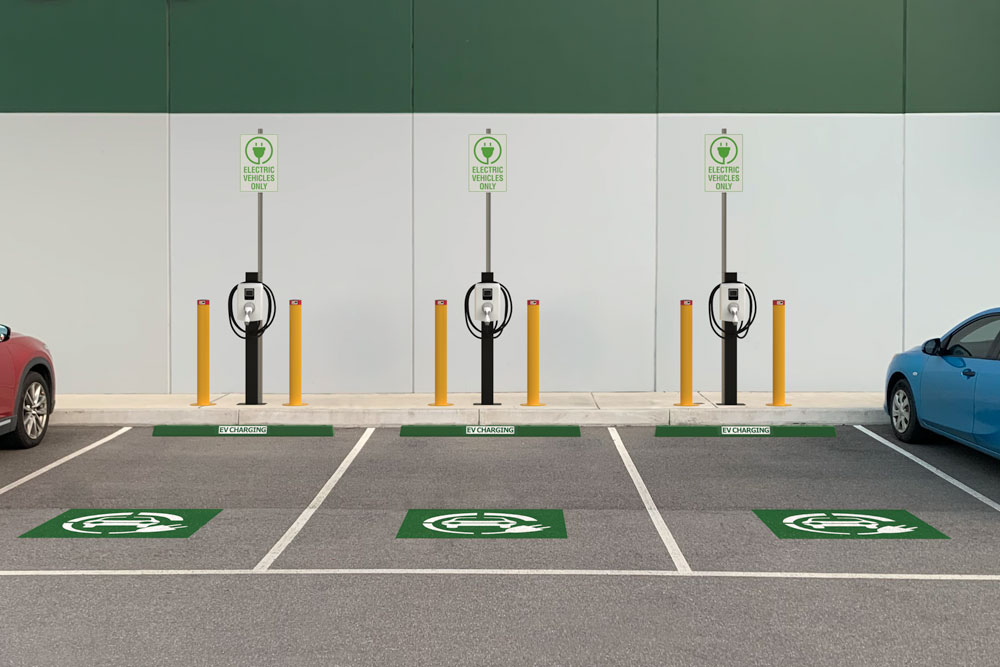
For years, an EV charger on a commercial site in Dubai or Abu Dhabi was a marketing gesture — a single bay near the entrance, installed to signal sustainability credentials. That framing is out of date, but the version replacing it is often wrong in the opposite direction.
The single most important thing a landlord needs to know before modelling on-site charging is this: public charging tariffs in the UAE are federally standardised. Rates were set under UAE Cabinet Decision No. 81 of 2024, with free charging for non-commercial users in Dubai ending in January 2025 and standardised tariffs established by the Ministry of Energy and Infrastructure. A property owner does not simply buy power at commercial rates and resell it at whatever the market bears.
That constraint shapes every ownership model discussed below.
The tariffs, and what they mean for a landlord
| Charging type | Rate |
|---|---|
| AC (destination charging) | Approximately AED 0.70 per kWh plus VAT |
| DC (fast charging) | Approximately AED 1.20 per kWh plus VAT |
| Home charging | Standard residential slabs, materially lower |
One recent development changes near-term revenue modelling: DEWA announced in February 2026 that new registered users receive free charging for the first year. A landlord underwriting a revenue share on per-kWh throughput should confirm how that promotional period is treated in the contract, because it affects the first twelve months of any new user cohort.
The practical implication is that the landlord’s return comes from space rental, revenue share and tenant retention — not from arbitraging a price the landlord sets. Where the margin exists, it is negotiated with the network operator, not extracted from the driver.
Four networks, not two
Coverage tends to frame this as DEWA in Dubai and E2GO in Abu Dhabi. There are at least four relevant players, and the differences matter for site selection.
| Network | Operator | Scale | Focus |
|---|---|---|---|
| DEWA Green Charger | Dubai Electricity and Water Authority | ~1,860 points (early 2026); target of 10,000 stations by end-2026 | Dense AC destination charging across Dubai |
| E2GO | ADNOC Distribution + TAQA joint venture | 400+ points UAE-wide (end-2025); target 750 by 2028 | DC fast-charging hubs, highways and corridors |
| Charge AD | Abu Dhabi | 1,000 stations at 400 locations (launched 2025) | Abu Dhabi Island, Al Ain, Al Dhafra |
| UAEV | Ministry of Energy and Infrastructure + Etihad Water and Electricity | Target 1,000 chargers by 2030 | Northern Emirates, highways, intercity routes |
One number needs care. The figure of 70,000 charging points is widely quoted alongside E2GO, and it is frequently misread as the venture’s build target. It is not. It is an estimate of what Abu Dhabi will require by 2030 to meet growing EV demand, requiring up to USD 200 million of capital expenditure across the market. E2GO was created to help meet that need, and its own trajectory is 400-plus points today toward roughly 750 by 2028.
For a landlord, the gap between market need and operator build rate is the opportunity: most of those points will not be installed by the two headline networks.
DEWA in detail
DEWA’s Green Charger initiative launched in 2014 and is the region’s oldest public charging network. As of early 2026 it counted more than 1,860 charging points, a figure that includes stations licensed by DEWA in partnership with public and private sector entities — which is the mechanism through which a private commercial site joins the network.
Operational scale as of mid-January 2026: 23,600 registered users. Since launch, the initiative has supplied more than 55,200 MWh, enabling EVs to travel over 276 million kilometres. DEWA operates four station types: ultra-fast, fast, public chargers and wall-mounted units.
The target of 10,000 stations by end-2026 implies a fivefold expansion from the current base. For a commercial landlord, that is both an opportunity to be included and a reason to move: the sites hosted early are the ones that shape driver habits.
E2GO in detail
E2GO is a joint venture between ADNOC Distribution and TAQA, unveiled at Abu Dhabi Sustainability Week in 2023, supported by a regulatory Policy for Electric Vehicle Charging Infrastructure launched by the Abu Dhabi Department of Energy, with backing from the Department of Municipalities and Transport.
Its logic is throughput, not coverage. ADNOC Distribution plans 20 charging hubs by end-2027, with 15 open by end-2026, along core national highways. The flagship is the Saih Shuaib megahub on the E11 between Abu Dhabi and Dubai, launched in January 2026 with 60 high-speed charging points capable of taking most EVs from 0 to 80% in around 20 minutes — described as the world’s sixth-largest superfast charging hub.
E2GO uses AI-powered Plug & Charge: once a vehicle is registered, it is recognised automatically on connection and billing is handled without a card or app. It also applies smart grid technology to balance load so high-speed charging does not strain supply at peak.
For a logistics or industrial landlord along an Abu Dhabi corridor, this is the relevant reference — not because E2GO will install on every site, but because it sets the throughput standard fleet operators will expect.
Why this is an amenity question, not a sustainability one
The instinct to file EV charging under corporate social responsibility undersells it, but the case should be made on the right grounds.
For office landlords, multinational tenants relocating regional headquarters increasingly include EV charging provision in fit-out requirements alongside cycling and end-of-trip facilities, as part of ESG-linked occupier mandates from global real estate teams.
For retail assets, the driver is dwell time. An EV charging on-site is present for thirty minutes to several hours, which converts to incremental footfall for F&B and retail tenants. The effect is real where dwell time is naturally long — regional malls and lifestyle centres — and largely absent in convenience-format retail, where a thirty-minute AC charge does not match a five-minute grocery run.
For logistics and industrial parks, the driver is fleet electrification. Third-party logistics operators converting last-mile fleets need depot or corridor charging under long-term supply contracts rather than one-off retail top-ups — a different commercial conversation from public charging, and one where the standardised public tariff may not be the governing rate.
For hospitality, guests charge overnight, giving a lower-intensity but highly predictable load that pairs with hosted or concession models rather than direct ownership.
Three ownership models
Fully hosted. DEWA or an approved partner installs, owns and operates the hardware on space leased or licensed from the landlord. Capital exposure is close to zero; so is upside. The landlord receives a fixed space rental or modest revenue share. Suits owners wanting amenity without balance-sheet exposure.
Concession. The landlord contracts a specialised charge-point operator under a revenue-share agreement, often with minimum guarantees. More of the margin shifts to the property owner while technical and maintenance risk stays with the operator. This is what most large mall groups and logistics-park operators are negotiating for new developments.
Direct ownership. The landlord installs and operates its own infrastructure. This captures the most margin but requires capital for hardware, installation, metering compliance and maintenance — and, critically, operates within the standardised public tariff framework rather than free pricing. Payback windows of three to five years are commonly cited for a modest bank of AC chargers, but that assumes utilisation the asset may not yet have.
What to check before signing
Interrogate four items beyond the headline point count:
- Tariff and revenue mechanism. How the standardised rate flows through to the landlord, and how promotional periods such as the free first year are handled.
- Term and renewal of the space licence. Charging infrastructure has a useful life that can outlast a short concession.
- Maintenance and uptime SLA. A charger frequently out of service destroys the amenity value it was installed to create.
- Electrical infrastructure upgrade. Older buildings may need substation or distribution-board work before any charger can be commissioned — a cost routinely underestimated in early feasibility.
Key takeaways
- Tariffs are federally standardised under Cabinet Decision 81 of 2024. The landlord’s return is space rental, revenue share and retention — not a price margin the landlord sets.
- Four networks, different logics. DEWA for dense AC coverage in Dubai; E2GO for highway throughput; Charge AD across Abu Dhabi; UAEV in the Northern Emirates.
- Read the 70,000 figure correctly. It is Abu Dhabi’s estimated 2030 requirement, not an operator build plan. E2GO is at 400-plus points targeting 750 by 2028.
- Match the model to the asset. Hosted for low-risk amenity, concession for shared upside, direct ownership only where utilisation supports the capital.
- Check the electrical capacity first. It is the constraint that most often turns a straightforward retrofit into a substation project.
Conclusions
The decision has moved from compliance gesture to a genuine real estate line item, but the economics are narrower than the enthusiastic version suggests. Rates are set federally, so the landlord is negotiating a share of a regulated revenue stream rather than setting a price. The two headline networks together account for a small fraction of what Abu Dhabi alone is projected to need by 2030, which means most installation will happen on private commercial sites under hosting and concession agreements.
DEWA’s density makes it the natural starting point for retail, office and hospitality assets in Dubai, with a fivefold expansion targeted by the end of this year. E2GO’s hub strategy is the relevant reference for logistics and industrial developers along Abu Dhabi’s corridors, less as a partner than as the throughput benchmark fleet operators will measure against.
The landlords who do well here will be the ones who treat electrical capacity as the first question rather than the last, and who read the revenue-share terms with the same care they apply to any other utility contract.
Information purposes only — not technical, financial or regulatory advice. Charging tariffs are standardised under federal decision and adjusted periodically; confirm current rates with the operator before modelling. Network point counts and expansion targets change frequently and should be verified at the point of decision.