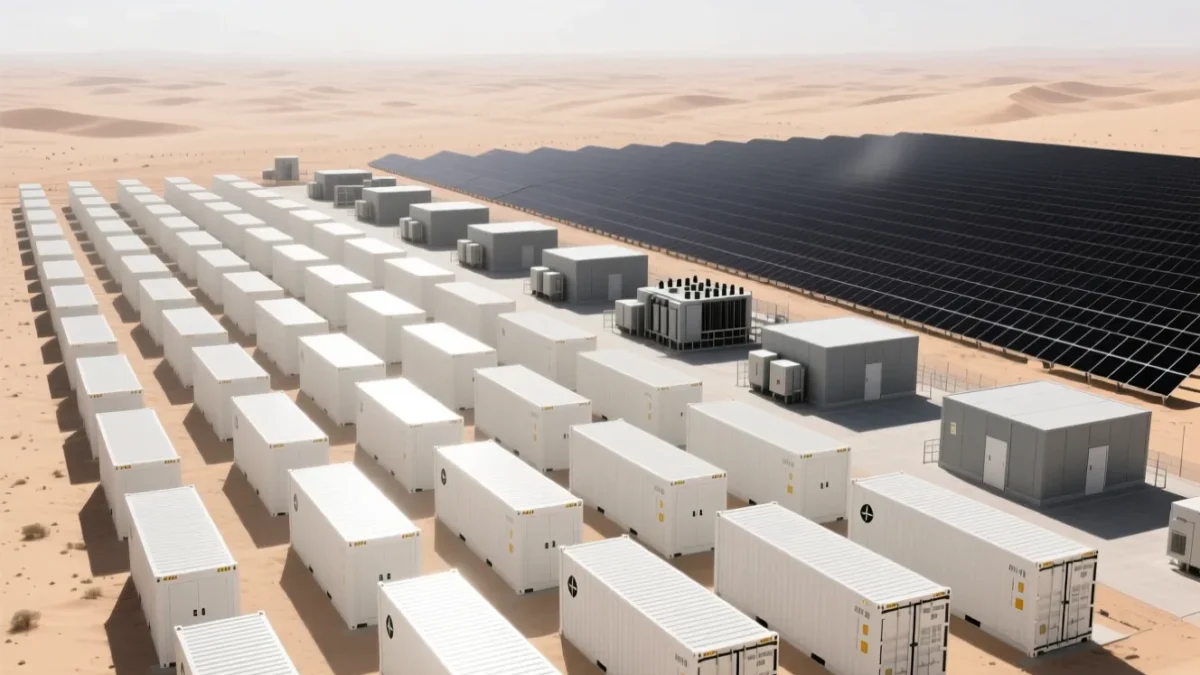
The number that matters most in Gulf power markets right now is not a generation figure — it is a storage figure. For years, the case against pairing solar with grid-scale batteries in the UAE rested on cost: batteries were expensive enough that firming up solar output into reliable, dispatchable power cost more than simply running a gas peaker for the same hours. That arithmetic has flipped. Between the 19 GWh battery system under construction at Al Dhafra and the 1,400 MW, six-hour storage block planned for Phase 7 of the Mohammed bin Rashid Al Maktoum (MBR) Solar Park, the UAE is building storage capacity at a scale that only makes sense if the underlying cost curve has moved decisively in batteries’ favour — and the data shows it has.
The headline capacity numbers
Two projects anchor the current build-out of grid-scale storage in the UAE. At Al Dhafra in Abu Dhabi, the Masdar–EWEC round-the-clock solar project pairs 5.2 GW of photovoltaic generation with 19 GWh of battery storage, sized to deliver roughly 1 GW of firm, continuous output. In Dubai, Phase 7 of the MBR Solar Park is planned to add 2,000 MW of photovoltaic capacity together with 1,400 MW of battery storage capable of six hours of discharge — a configuration explicitly designed to extend solar-derived supply into the evening demand peak, when Dubai’s grid load typically climbs as daylight generation falls away.
| Project | Location | PV capacity | Storage capacity | Design purpose |
|---|---|---|---|---|
| Al Dhafra RTC (Masdar–EWEC) | Abu Dhabi | 5.2 GW | 19 GWh | 1 GW firm, round-the-clock output |
| MBR Solar Park Phase 7 | Dubai | 2,000 MW | 1,400 MW / 6-hour discharge | Extend solar supply into the evening peak |
Why the cost curve flipped
Lithium-ion battery pack prices have fallen substantially over the past several years, driven by manufacturing scale in China, falling raw-material costs relative to their mid-decade peaks, and rapid improvement in energy density for the lithium iron phosphate (LFP) chemistry now standard in grid-scale storage. That decline has changed the comparison that matters most to Gulf utilities: the levelised cost of a firm megawatt-hour of solar-plus-storage versus the levelised cost of a megawatt-hour from a gas-fired peaking plant built specifically to cover the same evening hours.
A gas peaker carries a real capital cost, ongoing fuel cost tied to gas prices, and emissions that increasingly carry a shadow cost in green financing and disclosure frameworks. A solar-plus-storage system carries a higher upfront capital cost concentrated in the battery component, but effectively zero marginal fuel cost once built, and a generation source — Gulf solar irradiance — that is among the most productive and predictable in the world. As battery capital costs fall, the crossover point at which solar-plus-storage becomes cheaper than a gas peaker on a like-for-like, firm-capacity basis has moved earlier, and the UAE’s two flagship storage projects are a direct expression of utilities acting on that crossover.
Cost components: what actually goes into a grid-scale storage project
| Cost component | Trend 2023–2026 | Why it matters for UAE projects |
|---|---|---|
| Battery cell / pack cost | Declining, driven by LFP chemistry and manufacturing scale | Largest single line item in a BESS project; the primary driver of overall project economics |
| Balance of system (inverters, transformers, civil works) | Relatively stable | Less volatile, but grid-forming inverter technology (used at Al Dhafra) commands a premium over standard grid-following units |
| Land and site development | Low, given desert land availability | A structural UAE advantage versus land-constrained markets in Europe or East Asia |
| Financing cost | Favourable, given state-linked off-takers (EWEC, DEWA) | Long-term, creditworthy power-purchase agreements reduce the cost of capital versus merchant storage projects elsewhere |
Reading the forecast: a power market growing toward 68.08 GW
The build-out of storage capacity is happening against the backdrop of a UAE power market forecast to grow from approximately 54.15 GW of total capacity in 2026 to 68.08 GW by 2031, a compound annual growth rate of roughly 4.68%. That growth is driven by a combination of population and economic expansion, the electrification of transport and industrial processes, and the rising power demand of data centres and other continuous, high-intensity loads. Every gigawatt of new demand growth is, in effect, a decision point for grid planners: meet it with conventional thermal capacity, with additional nuclear baseload, or with solar-plus-storage capacity sized to deliver firm output. The scale of Al Dhafra and MBR Phase 7 suggests the UAE’s utilities are weighting that decision increasingly toward the third option, at least for the portion of new demand growth that can be served by firm renewable capacity rather than pure peaking plant.
What this means for buyers weighing on-site storage
The same cost dynamics playing out at utility scale are relevant, proportionally, to commercial real estate owners and industrial operators evaluating on-site solar-plus-storage for their own facilities. As grid-scale battery costs fall, the equipment costs available to commercial-scale, on-site systems fall in parallel, shortening payback periods for facilities that combine rooftop or ground-mounted solar with battery storage to reduce peak-demand charges or extend self-generated power into non-daylight hours. A related EnergyPoint analysis of Shams Dubai net metering economics for commercial assets sets out how that calculation plays out at the individual-building level; the utility-scale storage build-out described here is, in effect, the wholesale-market version of the same underlying cost shift.
Forecast summary
| Metric | 2026 | 2031 (forecast) | CAGR |
|---|---|---|---|
| UAE power market capacity | 54.15 GW | 68.08 GW | ~4.68% |
Key takeaways
- 19 GWh + 1,400 MW/6h — the UAE’s two flagship storage builds at Al Dhafra (Abu Dhabi) and MBR Solar Park Phase 7 (Dubai) represent the current frontier of grid-scale battery deployment in the GCC.
- The cost curve, not policy alone, is driving the build-out. Falling LFP battery costs have moved the crossover point where solar-plus-storage undercuts gas peaking capacity.
- Demand growth is the backdrop. A market moving from 54.15 GW to 68.08 GW by 2031 needs new firm capacity, and storage-backed solar is increasingly the utilities’ preferred way to supply it.
- The same math applies at building scale, shortening payback periods for on-site commercial storage investments.
Conclusions
The 19 GWh figure at Al Dhafra, and the 1,400 MW planned for MBR Solar Park Phase 7, are not isolated engineering choices — they are the visible output of a cost curve that has shifted decisively enough to change how Gulf utilities plan for reliable power. As the UAE’s power market grows toward 68.08 GW of capacity by 2031, the projects breaking ground today will set the template for how much of that new capacity arrives as storage-backed solar rather than conventional peaking plant. For energy buyers, developers and investors tracking the UAE market, the storage figures are now as important a metric to watch as the generation capacity headlines that have traditionally dominated the conversation.
Sources
- Al Dhafra round-the-clock project — 5.2 GW PV paired with 19 GWh of storage for roughly 1 GW of firm output (Masdar–EWEC): sungrowpower.com
- DEWA — MBR Solar Park Phase 7: 2,000 MW PV plus 1,400 MW / 6-hour (8,400 MWh) battery storage (November 2025): solarquarter.com
- UAE power-market capacity forecast — 54.15 GW in 2026 rising to 68.08 GW by 2031: mordorintelligence.com